At Wisdom 4 the Blind, we believe that knowing a resource exists is important — but helping someone gain access to that resource can be life-changing.
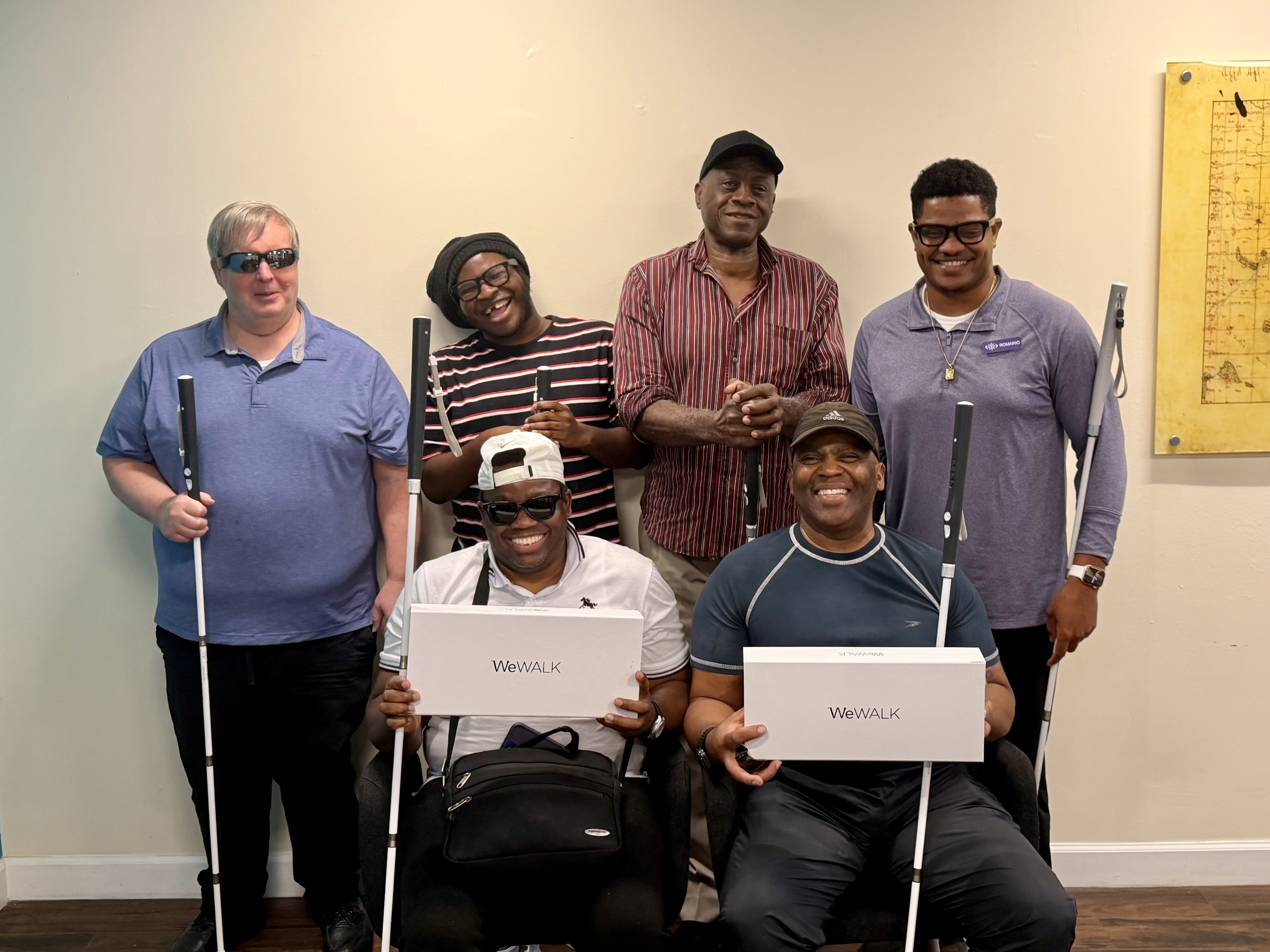
That belief recently became a reality for six members of the blind and low-vision community.
Through a generous donation from the Draper Foundation and a collaboration between Wisdom 4 the Blind and Florida Vision Technology, six individuals received WeWALK Smart Canes, giving them an opportunity to experience an innovative mobility technology designed specifically with people who are blind and visually impaired in mind.
For the recipients, these canes represent much more than a new piece of technology.
They represent access to information, exploration, mobility, and the opportunity to discover another tool for greater independence.
https://youtube.com/shorts/PtldomcKYd8?feature=share
What Is a WeWALK Smart Cane?
For generations, the traditional white cane has been one of the most important mobility tools available to people who are blind or have low vision. It provides essential information about the environment at ground level and, when paired with strong orientation and mobility skills, can allow someone to travel safely and independently.
The WeWALK Smart Cane builds upon that familiar tool by incorporating additional technology into the cane.
One of its primary features is an obstacle-detection sensor designed to identify certain obstacles above chest level — such as low-hanging branches or signs — that may not be detected at ground level by a traditional cane. When the system identifies an obstacle, the user can receive feedback through vibration or sound.
The Smart Cane can also connect with the WeWALK smartphone application. Depending on the device, region, and available services, users can access features such as accessible turn-by-turn navigation, information about nearby places, and public transportation information.
The goal isn't to replace the white cane or the skills that someone learns through Orientation and Mobility training.
Instead, it adds another layer of information.
Traditional cane skills remain essential, and WeWALK itself emphasizes that its obstacle-detection technology should not be used as a substitute for proper white-cane technique.
That distinction is important.
At Wisdom 4 the Blind, we believe assistive technology is most powerful when it works alongside good training, skills, and individual choice.
Why Assistive Technology Matters
Assistive technology has transformed opportunities for people who are blind and visually impaired.
A screen reader can make a computer accessible.
A refreshable braille display can turn digital information into tactile braille.
A video magnifier can make printed material accessible to someone with usable vision.
A smartphone can provide spoken navigation, identify objects, read printed text, access books, recognize currency, and connect someone to transportation.
And emerging mobility technology can provide travelers with additional information about the world around them.
These aren't simply "gadgets."
For the right person, with the right training, assistive technology can support education, employment, communication, travel, recreation, and everyday independence.
But there's another part of the conversation that is just as important:
People have to be able to access the technology in the first place.
Bridging the Accessibility Gap
New assistive technologies can provide exciting opportunities, but they aren't always financially accessible to everyone who could benefit from them.
That creates an unfortunate gap.
A device may exist that could help someone accomplish a goal, but knowing that the technology exists doesn't necessarily mean that person has the opportunity to try it, receive training on it, or determine whether it is right for them.
That's why partnerships like this matter.
The Draper Foundation's generous support made it possible for Wisdom 4 the Blind and Florida Vision Technology to put six WeWALK Smart Canes directly into the hands of people who can explore what this technology can offer.
For those six individuals, the question changed from:
"I wonder what that technology could do?"
to:
"Let's find out."
That opportunity is exactly the kind of access we want to help create.
Six Canes — Six Individual Experiences
It's tempting to look at a donation like this and focus on the number.
Six smart canes were donated.
But behind that number are six people.
Six different lives.
Six different experiences with vision loss.
Six different routines, destinations, challenges, and goals.
Assistive technology is never one-size-fits-all. What becomes an essential tool for one individual may not be the preferred solution for another.
And that's okay.
Independence isn't about prescribing one way for every blind or visually impaired person to navigate the world.
It's about providing people with options, information, training, and opportunities to determine what works for them.
These six recipients now have an opportunity to incorporate the WeWALK technology into their lives, learn its features, and decide how it fits into their personal approach to independent mobility.
The Power of Partnership
Projects like this don't happen because of one organization working alone.
They happen when people and organizations with different resources come together around a shared goal.
The Draper Foundation provided the generous support that made the donation possible.
Florida Vision Technology brought its knowledge and experience with assistive technology.
And Wisdom 4 the Blind helped connect that opportunity with members of the blind and low-vision community.
Together, those pieces created something tangible:
Six people received technology they now have the opportunity to use in their everyday lives.
This is the kind of partnership Wisdom 4 the Blind hopes to continue developing.
When foundations, businesses, assistive technology professionals, rehabilitation providers, educators, Veterans' organizations, nonprofits, and members of the blind community work together, we can help remove some of the barriers separating people from valuable resources.
Technology Is Only Part of Independence
As exciting as technology can be, we also believe it's important to keep it in perspective.
A smart cane doesn't create independence by itself.
Neither does a screen reader, braille display, magnifier, accessible app, or GPS system.
Technology is a tool.
Skills matter.
Training matters.
Orientation and Mobility instruction matters.
Accessible education matters.
Employment opportunities matter.
Community matters.
And most importantly, the goals and choices of the individual using that technology matter.
For someone using a WeWALK Smart Cane, traditional white-cane techniques remain essential. The technology is designed to supplement those skills by providing additional information — not replace them.
This is a philosophy we want to emphasize throughout Wisdom 4 the Blind.
We aren't interested in technology simply because it's new.
We're interested in what technology can help people do.
Can it make information more accessible?
Can it help someone pursue an education?
Can it remove a barrier at work?
Can it make traveling easier?
Can it help someone participate in an activity they enjoy?
Can it give someone another option?
Those are the questions that matter.
Creating Greater Access to What's Possible
This donation also represents the larger direction of Wisdom 4 the Blind.
Our goal is to become an educational resource for people who are blind or have low vision, their families, students, working-age adults, Veterans, educators, and anyone adjusting to vision loss.
There is an extraordinary amount of information available — but finding it can be difficult.
Someone experiencing vision loss for the first time may not know that Orientation and Mobility training exists.
A parent may not know what a Teacher of Students with Visual Impairments does.
A high-school student may not know about transition services.
An adult may not realize vocational rehabilitation could help them return to work.
A Veteran may not know about VA Blind Rehabilitation Services.
And someone who has used a traditional white cane for years may not know what newer mobility technologies are available.
Wisdom 4 the Blind wants to help connect those dots.
We want people to be able to come here and discover technology, training, programs, services, organizations, recreational opportunities, and other resources that they may not have known existed.
The WeWALK donation is one example of what can happen when awareness turns into access.
Continuing the Mission
This work also reflects the vision of Wisdom 4 the Blind's founder, Benjamin "Ben" Keeley.
Ben understood the value of connecting people.
He believed in education, technology, community, experiences, and giving people who are blind and visually impaired opportunities to discover what's available to them.
As Wisdom 4 the Blind moves forward, we want to continue building upon that foundation.
Sometimes that will mean sharing educational information.
Sometimes it will mean connecting someone with a blindness rehabilitation program.
Sometimes it will mean introducing people to new technology.
Sometimes it will mean creating an unforgettable experience.
And sometimes it will mean putting six smart canes into six people's hands and giving them the opportunity to see where those tools can take them.
One Step at a Time
We are incredibly grateful to the Draper Foundation for believing in this opportunity and providing the support that made these six WeWALK Smart Canes possible.
We are equally grateful to Florida Vision Technology for partnering with Wisdom 4 the Blind and helping connect innovative assistive technology with the people it was designed to serve.
Most importantly, we're excited for the six individuals receiving these devices.
We hope this is only the beginning.
Six smart canes.
Six individuals.
Six opportunities to explore something new.
And one shared belief:
Greater access creates greater possibilities.
Thank you to the Draper Foundation and Florida Vision Technology for helping Wisdom 4 the Blind continue moving forward — one step at a time.
Learn More About Assistive Technology
Assistive technology is highly individual. If you or someone you know is blind or has low vision, there are many tools and services available beyond smart canes — including screen readers, magnification, braille technology, accessible mobile devices, navigation tools, and independent-living technology.
Wisdom 4 the Blind is continuing to build our Blind & Low Vision Resource Library to help students, families, working-age adults, Veterans, and people newly experiencing vision loss find technology, training, and services that fit their individual goals.
Keep exploring. Keep asking questions. And keep discovering what's possible.

